What is it about?
A governed entity and its relationships in the Knowledge Graph.
The Knowledge Graph identifies what a forecast is about. The target defines exactly what is being predicted. The Open Forecast Receipt preserves the forecast, its forecaster, timing, context, and evidence as one verifiable record.
The Library answers four different questions without mixing them together.
A governed entity and its relationships in the Knowledge Graph.
A precise target, dimension, unit, cadence, and horizon.
A forecast sealed with its forecaster, timing, context, and provenance.
Integrity proof now; accuracy evaluation only after the target matures.
An entity is a stable real-world or conceptual thing. A target is a measurable property or outcome applied to that entity. A forecast is one forecaster's prediction for that approved subject-target binding.
The Library keeps the real-world subject separate from the measurable target. A forecaster predicts that subject-target binding, and an Open Forecast Receipt preserves the resulting forecast and its provenance.
Stable identities and typed relationships

Exactly what will be predicted
Who predicted what, when, and with which context
Market securities and macroeconomic forecasts use the same entity-plus-target contract.
One corporation issues two separately identifiable securities. Both can use the same target definition, but each subject-target binding keeps its own forecast history.
Context can connect several forecasts without becoming their target. GDP is measured about the country; the policy-rate target is measured about the Federal Reserve System.
The forecaster produces the forecast. The receipt seals it. A blockchain proof may anchor its digest, and evaluation happens only when the target can be resolved.
A human, AI model, algorithm, ensemble, hybrid, or organization produces a forecast.
Predicted values are tied to one approved entity-target binding and horizon.
The forecast, timing, context boundaries, evidence, and provenance are sealed together.
An optional blockchain attestation anchors the receipt digest without claiming accuracy.
After maturity, the forecast is compared with the governed observed outcome.
The current platform is focused on selected iPulse AI showcase assets. There are no public accounts, payment plans, or automated uploads. To propose a public forecast receipt, email support@ipulseai.com.
Follow a public proof from its Base transaction to the forecast values stored in Ethereum Attestation Service (EAS). Reading a proof is free: no wallet, connection, signature, or account is needed.
This worked example uses Alphabet / Google, Batch 6 on Base mainnet ↗. Each asset and batch has its own transaction and forecast UIDs. Use the proof linked from the forecast you are checking; these example IDs are not its proof.
On BaseScan, choose Logs beside Overview. In an Attested event, find Data → uid (bytes32) and copy the complete value. The example shows Logs (12); the number varies with the submission. Each event identifies one forecast, even when several forecasts share one transaction.
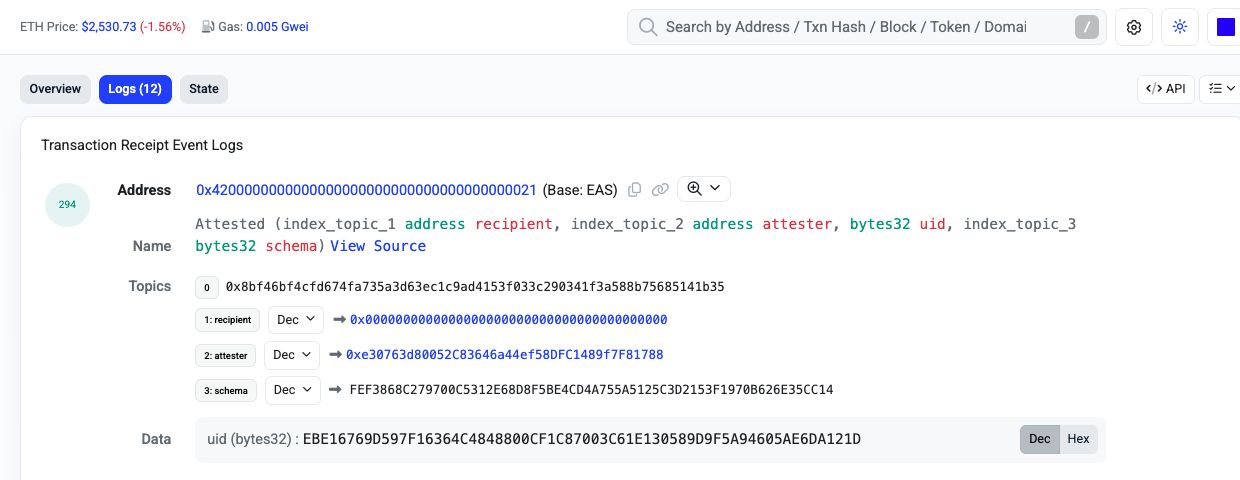
The transaction hash identifies the submission. The attestation UID identifies one forecast. The schema UID identifies the shared data format. They are different identifiers.
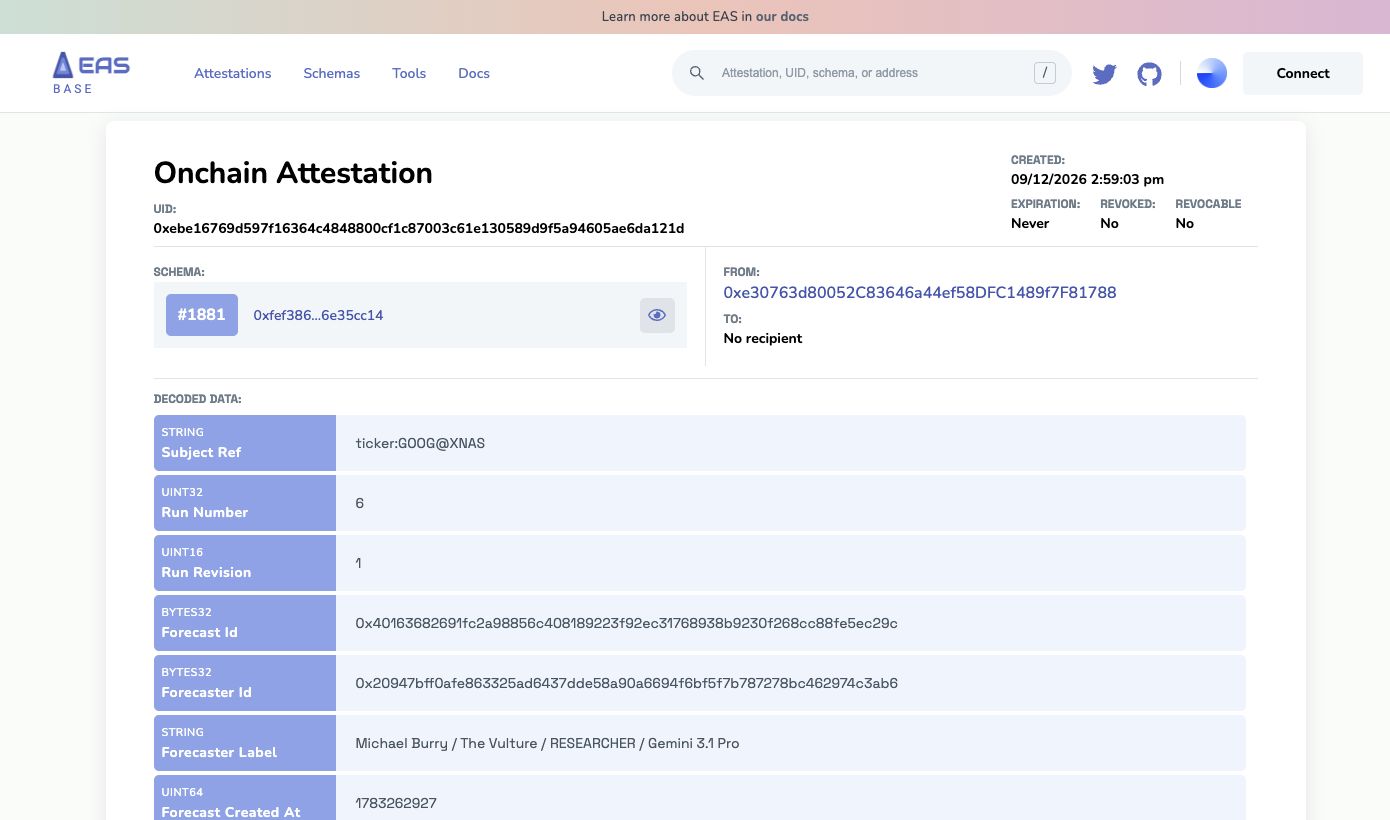
Open Base EAS Scan ↗, paste the UID into its search box, and open the matching attestation result. Add 0x at the start if BaseScan omitted it. BaseScan's event log does not currently provide a direct EAS link.
For this example, use:
0xebe16769d597f16364c4848800cf1c87003c61e130589d9f5a94605ae6da121dOpen the matching Google forecast attestation ↗Check that its UID matches. Near the bottom, Transaction ID should link back to the transaction you started from. A NVIDIA UID will not appear in Google's transaction logs.
Scroll to Decoded Data. Confirm the subject, batch, revision, and forecaster before reading the prediction. In this example, ticker:GOOG@XNAS means Google on Nasdaq, Run Number is 6, and Run Revision is 1. The named forecaster is an AI advisor persona using Gemini 3.1 Pro, not a forecast or endorsement by the real person.
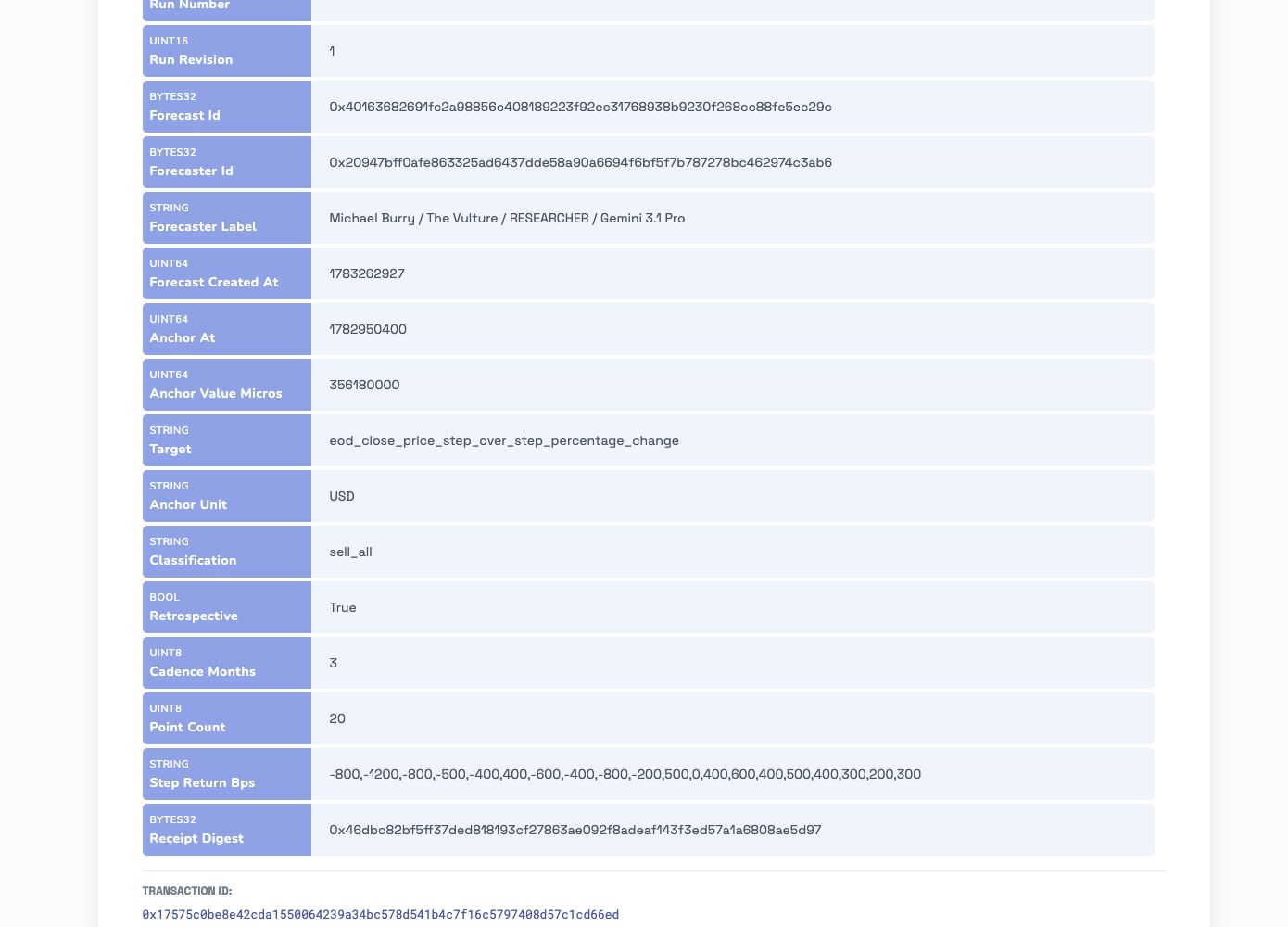
| Field | How to read this example |
|---|---|
| Anchor Value Micros | 356180000 ÷ 1,000,000 = $356.18. Anchor Unit is USD. |
| Cadence Months / Point Count | 3 months × 20 points = a five-year path. |
| Step Return Bps | Divide each value by 100 for a percentage. −800 means −8%, not −800%. Returns apply sequentially to the previous point. |
| Forecast Created At / Anchor At | Unix timestamps in seconds: forecast generation time and the starting market observation time. Neither is the blockchain publication time. |
| Created / Retrospective | The explorer's Created time is the onchain anchoring time (display timezone may vary). Retrospective = True means this anchor was published after the forecast. |
| Receipt Digest | The SHA-256 fingerprint linking this onchain projection to the complete receipt payload. |
These units describe the current market receipt profile. Other forecasting domains or schema versions may use different fields; always read the linked schema.
Open the corresponding Forecast Library receipt and download its JSON. The blockchain contains a compact forecast projection and digest; the receipt contains the fuller context and provenance. To verify the payload independently, canonicalize receiptPayload with RFC 8785 and compute SHA-256. Compare that digest with Receipt Digest on EAS (ignoring only the hexadecimal 0x prefix). Hashing the entire JSON file, including its proof envelope, will not produce the same digest.
Screenshots captured from public BaseScan and Base EAS Scan pages on 12 September 2026. Explorer layouts may change. This is a read-only tutorial.
The sections below define the portable JSON contract, deterministic digest, optional blockchain attestation, and current reference implementation.
An Open Forecast Receipt (OFR) is a structured, provenance-aware forecast record defined by the ofr-core-v0.1.0, ofr-market-v0.1.0, and ofr-ai-v0.1.0 profiles. It binds a market prediction (anchor price, cadence, step returns) to cryptographic integrity verification and, when published, to an Ethereum Attestation Service (EAS) record on the network identified by its proof. The live Batch 6 Showcase uses Base mainnet; development examples use Base Sepolia. The goal is transparent, verifiable, and portable forecast data while making the limits of each proof explicit.
Every OFR follows the JSON Schema at https://ipulseai.com/schemas/open-forecast-receipt/v0.1.0/schema.json. The schema defines five required top-level sections: $schema,specVersion,profiles,receiptPayload, andproofEnvelope. The immutable payload contains receipt identity, issuer, forecast, temporal and generation provenance, evidence, and disclosure. The proof envelope contains the payload digest and independently mutable proofs. The schema uses additionalProperties: false to reject unknown fields.
A ticker is a point-in-time market identifier, not the permanent identity of a company or instrument. Each receipt therefore binds an issuer-stable subject.idand snapshots the ticker, MIC, ISIN, and other available identifiers that applied to that forecast. Public asset URLs use a stable navigation slug with optional aliases. If a company changes its ticker, the current subject registry and URL aliases may be updated, while historical receipts, identifiers, digests, and attestations remain untouched.
The sealed payload digest is computed as follows:
receiptPayload. The proof envelope is never part of its own digest.json-canonicalize v2).proofEnvelope.payloadDigestSha256.When published, an OFR's key fields (17 fields covering market identity, prediction parameters, and the receipt digest) are encoded as an EAS attestation on Base mainnet (chain ID 8453), or Base Sepolia for test proofs (chain ID 84532), at contract 0x4200...0021. The EAS schema uses bytes32 receiptDigest and is non-revocable. Its deterministic schema UID is 0xfef3868c279700c5312e68d8f5be4cd4a755a5125c3d2153f1970b626e35cc14. The initial retrospective showcase selects 0 receipts across all five public assets; 0 currently have verified attestations.
The blockchain status axis shows whether the receipt's digest has been attested onchain. A selected but unissued receipt remains explicitly labeled not_issued. When a real UID is available, the app reads the EAS contract on the proof's declared network, ABI-decodes all 17 fields, and compares the onchain digest against the locally computed digest and reports one of: verified, revoked, pending, or unavailable.
The PepsiCo/Ray Dalio fixture is the canonical data source for this explorer. It represents Batch 6, run 6, revision 2 of the iPulse AI forecast pipeline for PepsiCo, Inc. (PEP:XNAS). The fixture is a retrospective receipt — created after the original forecast was published — and carries issuanceMode: "retrospective". The forecast was generated by the Gemini 3.1 Pro AI model (Google DeepMind), using theRay Dalio / The Strategist / RESEARCHER advisor persona. The 20-step forecast starts with -4.00% and -3.00% step returns. The compact onchain projection stores those same values internally as -400 and -300 basis points so it can use deterministic integers. The terminal reconstructed price is approximately $180.61(anchor $144.22 × compound 25.23% return). Its researcher response was generated at 2026-07-05 14:48:47 UTC. The canonical payload digest is 85e82d4748...60ea4a5.
The public Library reads published collections, subjects, forecast indexes, receipts, and proof metadata from Cloud Firestore. The original reviewed Batch 6 JSON examples remain only as immutable test vectors and as the one-time source for the controlled Firestore import; the running application does not use them as its database. A network-specific RPC read occurs only when a receipt has a non-null attestation UID.
The first reference implementation began during the AI Factory Hackathon with builder.nativelyai.com. It is now maintained by Future Edge Group as the public iPulse AI forecast showcase and open-source verification toolkit.
Drag nodes, pan the canvas, zoom, or select any object to inspect its role.